


Oil Mist Collectors
Smart-Alert Flagship Series
GEP-200M / GEP-300L
Upright vortex impeller draws air first, then filters — higher airflow and lower vibration than horizontal units.

Pollution-control equipment for machine tools · Designed and made in Taiwan
Since 2011, GREEN ECO PRO has built pollution-control equipment for machine tools: oil-mist collectors, coolant purification, chip and sludge removal, and precision filtration. Tell us about your machines, coolant tanks and the problems you see on the floor, and we'll work out the right model together.
Coolant purchasing, manual skimming and tank cleaning, and outsourced waste-fluid disposal often add up to more than the equipment itself. GREEN ECO PRO separates tramp oil and contaminants by physical means — no additives, and no change to the coolant's original concentration. How much you save depends on your machining, fluid type and volume, and has to be assessed on site.
There is no universal figure for the improvement. The result depends on machining method, coolant type, number of machines, and your current change and cleaning intervals. Send us your tank capacity and maintenance cycle and we will help you estimate it.
First identify whether the problem is in the air, the fluid or the tank bottom — then choose the right equipment.
Extract machining oil smoke and fine particulates at the source, preventing mist from spreading across the plant.

Continuously remove surface tramp oil to reduce the oil layer anaerobic bacteria depend on — without changing the coolant's original concentration.

Continuous vacuum filtration intercepts settled sludge, so the CNC never has to stop for tank cleaning.

Integrated air, water and waste control equipment, re-planned to your line's conditions and space limits.

Full model numbers, spec tables and options are on each product page. Not sure which model fits? Just tell us about your site.
Oil Mist Collectors
GEP-200M / GEP-300L
Upright vortex impeller draws air first, then filters — higher airflow and lower vibration than horizontal units.

Coolant Purification Systems
ULTRA-360
Built-in oil tank and standard filter-clean gauge; the element is washable and reused, running continuously.

Chip Vacuum Removal & Precision Filtration
FC180 / FC180 Plus / FC380
Continuous vacuum filtration captures iron chips, aluminium mud and tungsten powder.

Chip Vacuum Removal & Precision Filtration
FCG-105
Filtration precision to 5μm; Japanese-imported submersible pump for continuous circulation.

Water Treatment & Peripherals
UV-135
UV-C light irradiates the passing coolant and damages microbial DNA, used to suppress tank odour and bacterial counts.
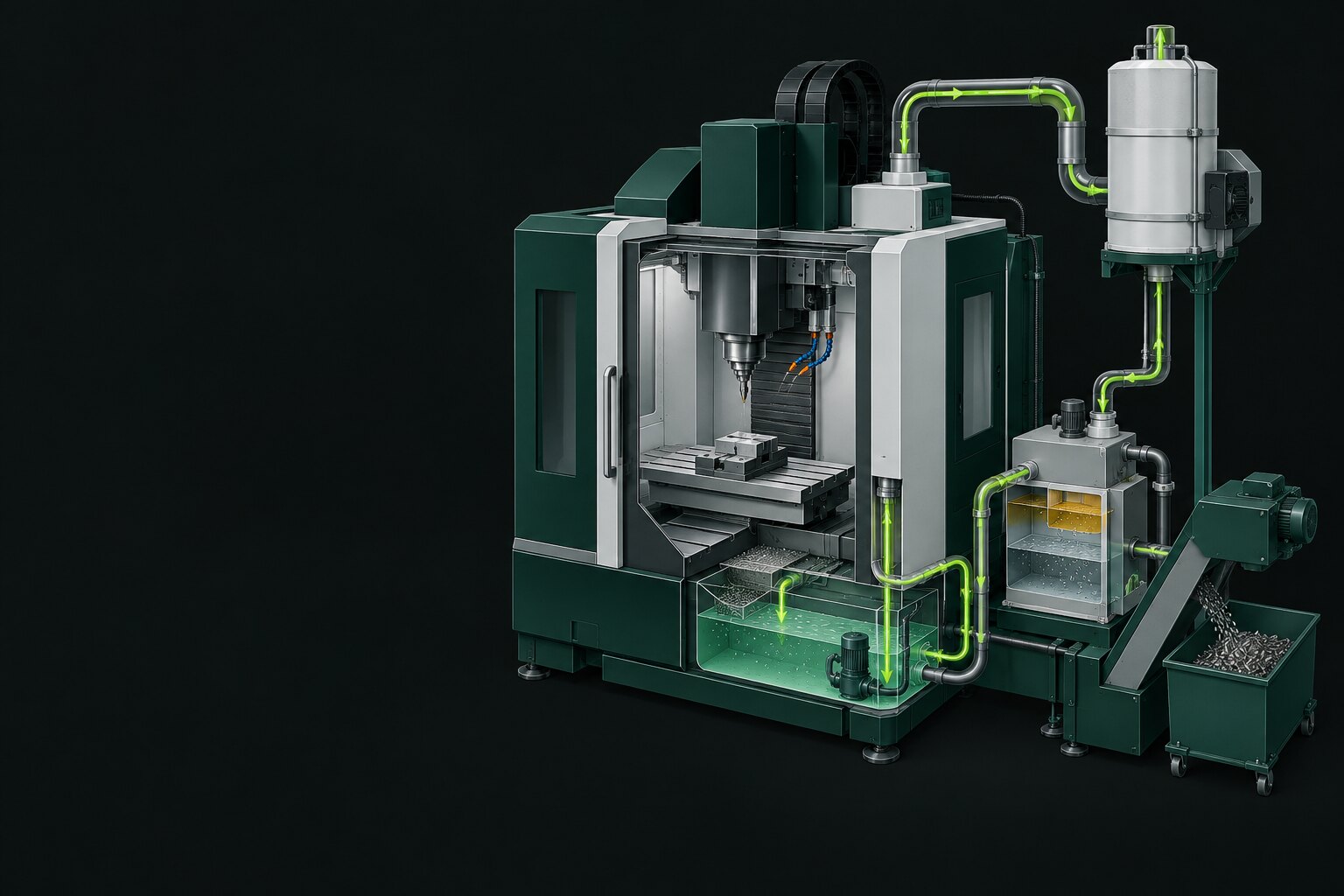
Air and liquid follow two different paths, and the liquid side splits again by contaminant. Below is what each path passes through and what it leaves behind. Everything is handled physically, without altering the coolant's original concentration.
One machine generates several things at once: atomised oil smoke, tramp oil floating on the surface, metal chips settling at the bottom of the tank, and suspended fine powder. They behave differently, so they are handled on different paths.
Atomised oil smoke and fine particulates
Leaked oil floating on the coolant surface
Iron chips, aluminium sludge and tungsten powder on the tank floor
Very fine powder from grinding and EDM
Tank odour and bacterial counts
Equipment by layer
Atomised oil vapour rises. The GEP series extracts at the source, capturing 5μm particulates.
View Oil Mist Collectors equipmentLeaked oil floats on top and blocks oxygen. The skimmer and S.T.P.M module separate it continuously.
View Coolant Purification Systems equipmentThe fluid itself must keep concentration and cleanliness. FCG filters to 5μm; UV-C suppresses microbes.
View Chip Vacuum Removal & Precision Filtration equipmentHeavy impurities settle at the bottom and take up capacity. Vacuum draws them continuously — no CNC downtime.
View Chip Vacuum Removal & Precision Filtration equipmentWithin the same industry, different machining methods create different pollution. Start from what you see on site, then check the conditions and the matching equipment.
On lathes, mills and machining centres, oil mist builds up inside the enclosure and escapes when the door opens.
Related industriesMachine Tools, CNC Precision Machining, Metalworking
Way oil and hydraulic oil leak into the tank and float on the coolant surface.
Related industriesMachine Tools, Automotive & Transportation, Aerospace Machining, Heavy Industry
The first start-up after a holiday smells worst, and the fluid needs changing more and more often.
Related industriesMetalworking, Automotive & Transportation
The chip conveyor can’t carry them out, and cleaning means stopping to drain the tank.
Related industriesBicycle Industry, Aerospace Machining, CNC Precision Machining, Heavy Industry
Particles too fine for an ordinary filter basket stay suspended in the fluid.
Related industriesPrecision Technology
Off-the-shelf models don’t fit, or several units need to work as one system.
Related industriesMachinery Manufacturing, Heavy Industry
Related industries are drawn from GREEN ECO PRO’s existing installation records. Final selection still depends on the machining method, coolant type and fluid volume on site.
Across machine tools, precision technology, aerospace, bicycles, transportation and heavy industry. The records cover direct purchases, equipment supplied with new machines, and trial installations, so the type of engagement varies.


Trademarks belong to their respective owners and indicate an installation record only, not an endorsement of our company. See each case page for the type of engagement and year.
Machine Tools
In August 2015, the Taichung Machinery audit team visited GREEN ECO PRO and pass…
View full caseMachine Tools
GREEN ECO PRO pollution-control equipment installation record.
View full caseMachine Tools
GREEN ECO PRO pollution-control equipment installation record.
View full caseGREEN ECO PRO focuses on pollution-control equipment for the manufacturing floor. Made up of environmental-engineering, mechatronic, industrial-design and safety professionals, we keep developing efficient, low-cost environmental improvement equipment.

What to prepare at each step, and what you get back. The more complete the information, the faster the assessment.
Launching new products including the UV sterilizer and chip-guard strips. 3/6–3/11, Nangang Hall 2, 4F, Booth S1228.
022022 ExhibitionTaipei Nangang Exhibition Center Hall 2, 4F, Booth S1431. Showcasing the full range of pollution-control equipment.
122021Year-end message — the severe pandemic is finally behind us as we welcome a brand-new 2022.
Tell us your machining equipment, coolant type and on-site problems, and we'll help assess the right pollution-control solution.